RCM Services
Psychiatric Coding Services

In the modern US healthcare landscape, medical coding is no longer just a back-office administrative task—it is the financial heartbeat of your clinic. As we progress through 2026, the "silent leak" caused by coding inaccuracies has reached a critical breaking point. While many physicians focus on increasing patient volume to boost income, the reality is that up to 12% of annual revenue is vanishing due to preventable coding mistakes and inefficient medical billing services.
Statistics show that nearly 50% of denied claims are never resubmitted. Busy in-house staff often focus on new billings, leaving thousands of dollars in "soft denials" to expire past their 90-day timely filing limits. This is exactly why a growing number of providers who need medical billing services are switching to specialized firms that offer dedicated denial recovery teams. By ensuring every dollar is chased down, these services turn potential losses back into practice profit.

Understanding the True Scope of Medical Coding & Billing Errors
The complexity of the US billing system in 2026 is staggering. With recent ICD-10-CM updates specifically targeting chronic disease management and the expansion of telehealth-specific CPT codes, the margin for error is razor-thin. Industry benchmarks reveal that approximately 80% of all medical bills contain at least one error.
Common Sources of "Micro-Errors" in 2026
These errors often trigger automated payer "scrubbers" that result in immediate rejections:
- Unbundling: Coding components of a procedure separately when a single comprehensive code exists.
- Upcoding and Downcoding: Billing for a higher level of service than documented (inviting audits) or under-billing (losing earned revenue).
- Specificity Gaps: Using a "General" diagnosis code when 2026 guidelines require a high-level "Lateralized" or "Chronic-specific" code.
The Financial Impact of Denials
The cost of a denial is two-fold: the lost revenue and the massive administrative cost to recover that money. In 2026, the stakes have never been higher.
The $57 Rework Reality
Recent data shows that the administrative cost to rework a single denied claim has spiked to an average of $57. For specialty surgery claims, this can exceed $100 per claim. When you multiply this by hundreds of denials a month, you aren't just losing the original claim value—you are paying a "tax" on your own mistakes.
The "Never-Recovered" Revenue Trap
Statistics show that nearly 50% of denied claims are never resubmitted. Busy in-house staff often focus on new billings, leaving thousands of dollars in "soft denials" to expire past their 90-day timely filing limits. This is where professional medical billing services provide the most value by ensuring every dollar is chased down.
Why Medical Billing Errors Happen — and Why They’re Increasing
If it feels like getting paid is getting harder, it's because it is. Three primary forces are driving error rates higher in 2026:
1. AI-Driven Payer Scrutiny
Insurers like UnitedHealthcare and Aetna are now using "Agentic AI" and Natural Language Processing (NLP) to scan claims. If your documentation doesn't perfectly mirror the CPT code, the algorithm rejects it instantly.
2. The "Great Retirement" of Certified Coders
Experienced US coders are retiring at record rates, leaving practices to rely on less-experienced staff who may struggle with the intricate 2026 compliance standards.
3. Eligibility Volatility
With shifting Medicaid redeterminations and ACA subsidy changes, "Eligibility Not Found" has become a leading cause of denials. Real-time verification is no longer optional; it is a necessity.
The CBS Solution — Prevention Through Audit and CDI
To stop the bleeding, high-performing practices are shifting from "Reactive Billing" to Revenue Integrity. The solution lies in a proactive framework that focuses on the root cause of the error.
Clinical Documentation Improvement (CDI)
CDI is the process of ensuring the medical record accurately reflects the patient's severity.
- Example: A doctor notes "Diabetes," but a CDI specialist ensures it is recorded as "Type 2 Diabetes with Diabetic Chronic Kidney Disease, Stage 3." This shift drastically changes the reimbursement and risk-adjustment (HCC) score.
The Power of Pre-Submission Audits
Don't wait for the denial to find the mistake. Elite medical billing services use "Predictive Scrubbing" to catch CPT/ICD mismatches before the claim leaves your office. By ensuring a 95%+ Clean Claim Rate, you stabilize your cash flow and reduce your "Days in AR."
Medical Coding & Billing Accuracy Is Profit
At the end of the day, your practice’s profitability isn't determined by how many patients you see, but by how many claims you close on the first attempt.
The 2026 Revenue Benchmark Table
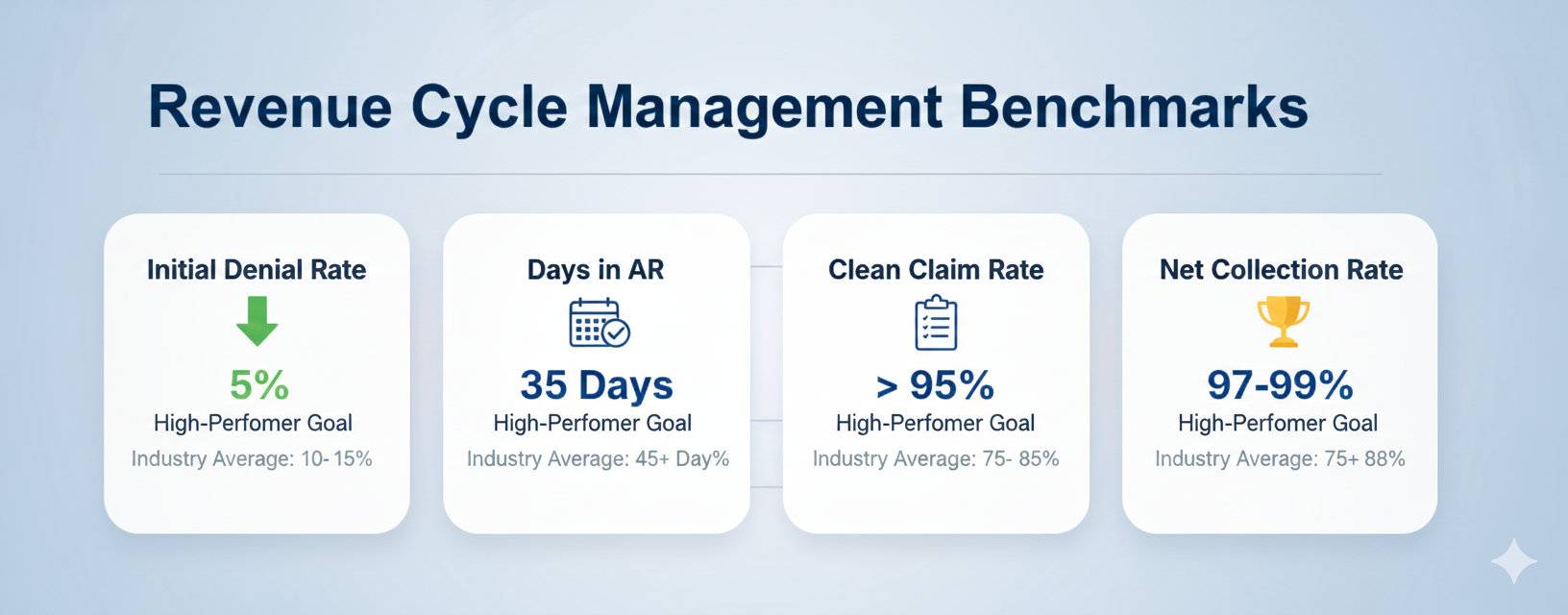
Compare your practice to the current industry high-performers:
| Metric | Industry Average | High-Performer Goal |
| Initial Denial Rate | 10% – 15% | < 5% |
| Days in AR | 45+ Days | < 35 Days |
| Clean Claim Rate | 75% – 85% | > 95% |
| Net Collection Rate | 88% | 97% – 99% |
Conclusion: Turning Accuracy into Assets
In 2026, accuracy isn't just a compliance requirement; it is your most effective tool for profit growth. Moving from a 12% error rate to a 2% error rate for a practice generating $2M annually is an immediate $200,000 increase in take-home pay—without seeing a single extra patient.
Stop letting "micro-errors" dictate your clinical success. By investing in precision coding and a disciplined denial response, you turn your billing department from a cost center into a profit engine.